
Why Trump Wants Greenland and Why It Matters to the World
After a series of geopolitical events that have heated up the global political landscape, the issue of Greenland has once again moved to the top of President Donald Trump’s foreign policy agenda. What initially sounded like a joke during his first term has now taken on a more serious and practical trajectory.
The idea of acquiring Greenland is no longer treated as a casual remark but as a strategic proposition. This raises important questions: Why Greenland? What does it represent in today’s geopolitical environment? And what does this mean for smaller nations watching from the sidelines?
What Is Greenland All About?
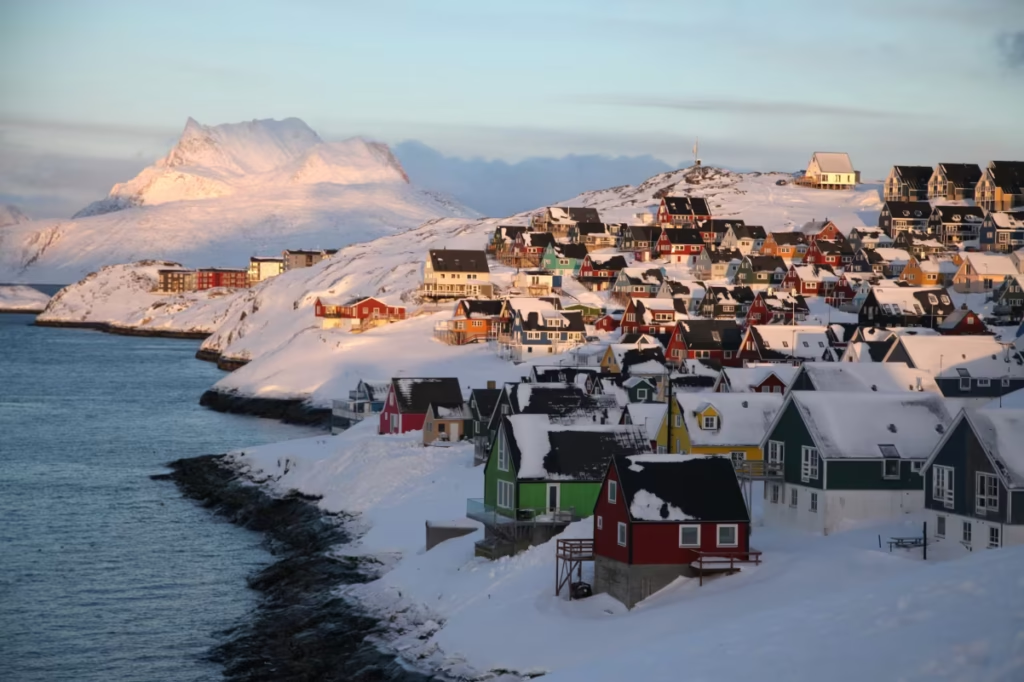
Greenland is the world’s largest island and is technically part of the Kingdom of Denmark. It is inhabited primarily by Inuit communities whose ancestors migrated from what is now Canada thousands of years ago.
Historically, Greenland has been connected to European kingdoms for more than a millennium. Norse settlers from Norway arrived in the 10th century and remained for several centuries before disappearing in the late 15th century. The Inuit arrived in the 13th century and remain the dominant population today. Following the separation of Denmark and Norway in 1814, Greenland came under the Danish crown. In 1953, Greenland’s colonial status ended, and it became an integral part of Denmark. In 1979, Greenland gained home rule through a referendum, and today it enjoys extensive self-governance. With a population of just over 56,000 people, mostly concentrated along the southwest coast, Greenland is the least densely populated territory in the world. Economically, it remains heavily dependent on financial transfers from Denmark, which account for nearly half of its public revenue.
Is This the First Time the United States Tried to Acquire Greenland?
No. The United States first attempted to purchase Greenland in 1946, offering Denmark approximately $100 million. Denmark firmly rejected the proposal, viewing Greenland as an integral part of the Danish kingdom and national identity. In 1951, Denmark and the United States signed the Greenland Defense Agreement, allowing the U.S. to maintain military bases on the island, including the strategically important Thule Air Base. This arrangement already gives the United States a significant military footprint in Greenland.
President Trump’s renewed interest reflects a desire for full control rather than mere access. While he emphasizes acquisition through negotiation rather than force, his rhetoric suggests that strategic necessity may override diplomatic sensitivity.
What Is the Current Situation?
European Union states and NATO members have expressed strong solidarity with Denmark, emphasizing that Greenland belongs to the Kingdom of Denmark and that its future must be decided by the Greenlandic people. Any unilateral U.S. attempt to acquire Greenland would create a major rift within NATO. Ironically, such a move would weaken the very alliance that the United States relies on to counter Russia and China.
Why Is Greenland Strategically Important to the United States?
Greenland sits at a critical geopolitical crossroads between North America and Europe, in the rapidly transforming Arctic region. Due to climate change, Arctic ice is melting, opening new sea routes and access to untapped natural resources such as rare earth minerals, hydrocarbons, and fisheries. Russia already has a long Arctic coastline and is actively militarizing the region. China, though not an Arctic state, is investing heavily in Arctic research, infrastructure, and partnerships.
Control over Greenland would give the United States, strategic military positioning in the Arctic, greater influence over emerging Arctic shipping routes, access to future resource extraction zones, geopolitical counterweight to Russia and China in the far north.
Thus, Greenland represents not land, but power, positioning, and future dominance.
What Can Smaller Countries Learn from This?
For countries like Sri Lanka, this situation offers a sobering lesson. Sri Lanka sits at a strategic crossroads in the Indian Ocean, one of the world’s most important maritime regions. South of Sri Lanka lies a vast uninterrupted stretch of ocean up to Antarctica, except for a few islands such as Diego Garcia, which is controlled by the UK and hosts U.S. military facilities.
Today, the idea of a powerful country seeking to acquire Sri Lanka sounds absurd just as Trump’s Greenland remarks once did. Yet history shows that strategic geography can quickly turn peaceful places into geopolitical prizes.
The emerging global order increasingly resembles a return to power-based politics, where military strength and economic influence matter more than moral arguments, democratic values, or international norms. Smaller nations may find that their sovereignty depends not only on law, but on alliances, diplomacy, and their ability to remain strategically relevant without becoming strategically vulnerable.
In Nutshell
Greenland is not just about Greenland. It is a symbol of a shifting world order in which geography, power, and resources once again dominate international relations. For the United States, pursuing Greenland may seem rational from a strategic standpoint. But for the rest of the world, especially smaller nations, it is a reminder that sovereignty can never be taken for granted, and that in geopolitics, ideals often yield to interests. In this new era, it is not values alone that shape the world but power, positioning, and preparedness.